Todays session was focused on recording my acoustic guitar parts for my piece. I wanted to used two se5 small diaphragm pencil condenser mics pointing at the 8th and 12th fret of the guitar. For my variation, I wanted to add the Neumann u87 large diaphragm condenser mic directed at the sound hole with one se5 mic pointed at the 8th fret whilst the other directed at the bottom of the guitar. I realised, however, that it would be more time efficient to record only the latter variation of the piece and utilise faders more in order to create two entirely different mixes.
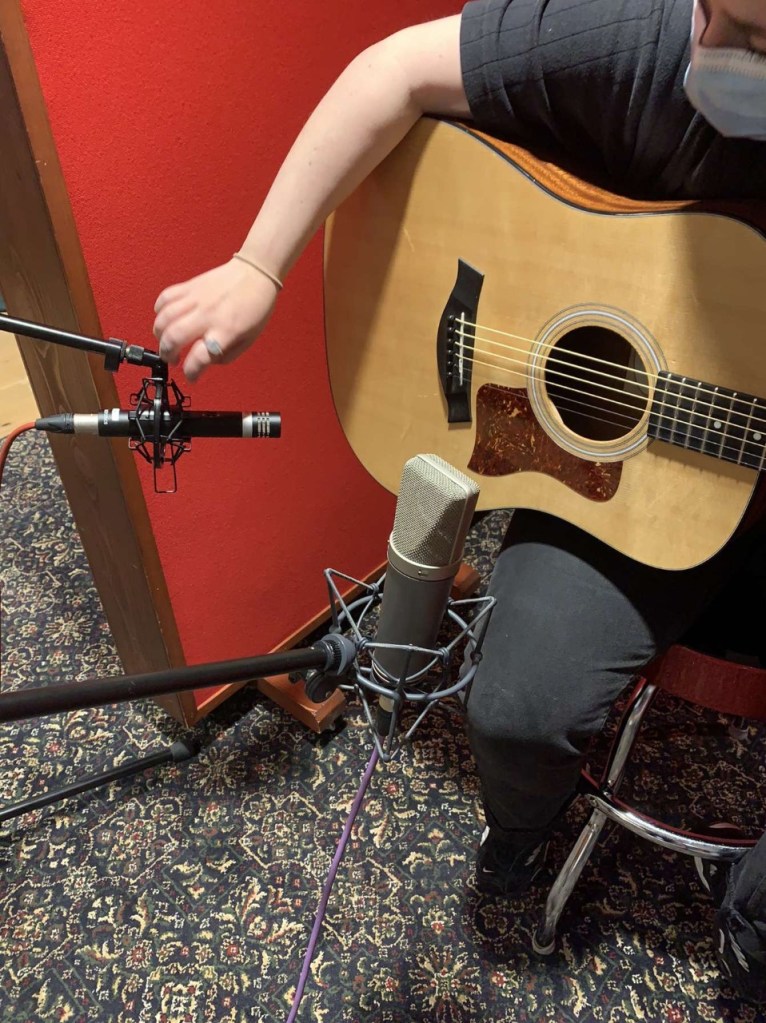
I started up by collecting the microphones, microphone stands, cable, three panels, a stool and of course, a guitar. I placed the panels surrounding the stool and guitar and set up two mic stands roughly where the mics would need to be placed. I then and attached the sE5 microphones and had Caitlin align them properly based on how I would be holding the guitar.
I then set up my project on Pro tools which consisted of three mono audio tracks for the microphones, a stereo master fader to control the volume of the entire project as well as a click track to help keep me in time.
After this, I connected the left side sE5 to input 1 on the snake cable stage box corresponding with Mic 1 on the stage box. I connected the Neumann to input 2 on the snake cable which then connected to Mic 2 on the stage box. Finally, the right side sE5 connected to input 3 on the snake cable which corresponded to Mic 3 on the stage box. I then connected some headphones so that I will be able to hear the talkback as well as the click track.
The mixing desks gives us control over what is happening on the pro tools project. The signal flow from the mics is then be picked up by the C24 Mixing Desk in the control room. It then goes through the Pro-tools HDX and is then sampled to go onto the Pro-tools project. The mixing desk is built up of various sections; Monitor – controls volume and gain levels heard in the studio and in microphones, input – controls the levels being recorded from the microphones onto the project and control – controls EQ, Plugin and fader levels. The C24 mixing desk works exclusively with pro tools and allows us to control elements of the project such as input gain levels, plugins, EQ and insert. It also includes channel elements such as faders for individual mics as well as mute and solo options.

I started off my recording by first finding the tempo of the in order to set the click track which was around 120bpm. I recorded multiple takes in order for me to have a variety of options to choose from. I faced problems when recording the bridge of my piece as it was too complex and I continuously made mistakes. After trying to edit different takes together, the transition was not as seamless as I would have liked and so I decided to change the riff completely to make it easier to record. This turned out to be the best option as I was able to record the whole song in one take multiple times, meaning the editing stage will be much easier than it would have been prior to the change.
Originally, wanted to record a piano part for my original piece, in which I would records backing chords mimicking those used by the lead guitar in order to add depth and texture to my piece . After much thought, I decided that for this song, it would be more fitting to simply record the backing chords on the guitar. This is also more time efficient as the guitar set up was already ready as well as the fact that recording piano takes a long time to set up and perfect as well as record.
I used the same set up for the guitar, utilising three sound panels, however only using theNeumann U87 Large Diaphragm Condenser Mic, directed 6 inches away from the sound hole. This was because I wanted the backing chords to be deep, warm and rich which, after using this microphone to record the lead guitar part for this piece, is provided by the Neumann. I also wanted these chords to sound full which is my reasoning for positioning the mic closer to the sound hole. I added another mono audio track to my Pro Tools project to direct the microphone to the software and recorded multiple takes.
My aim for the next session is to begin the editing and mixing stage of my assignment. I believe what went well in this stage of my assignment, was the fact that I got all the recordings done in a time efficient manner whilst still recording a professional sounding piece. The main struggle I faced with today was making the final decision to change my composition and utilise what was better for the mix as well as for time efficiency.
 Sarahs Sound Dubbing Blog